
Addressable vs. Conventional Fire Alarm Systems
HOW TO TELL THE DIFFERENCE

🟥 Conventional Systems
These are older, simpler systems.
How they work
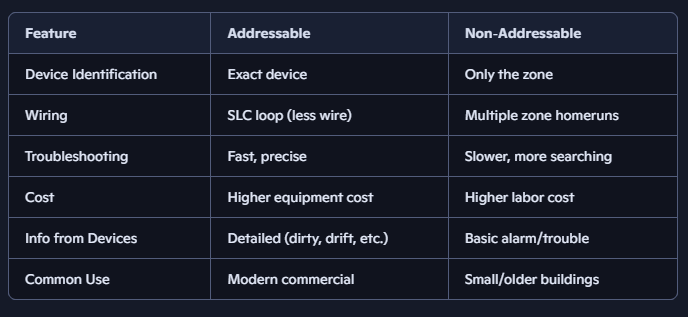
Devices (i.e., smokes, heats, pulls) are wired in zones. If something goes off, the panel only tells which zone needs troubleshooting, and not the exact device.
For example: “Zone 3 Alarm” → somewhere in that zone, something tripped.
What this means in the field is this system requires more wire beucase each zone is its own homerun. Troubleshooting is slower because we’re hunting through the whole zone. The equipment is cheaper but it’s made up in the cost of labor to install and maintain the system.
When we see them
Small buildings
Older installations
Basic systems with only a few devices
Video: Joe Klochan Explains How Conventional Fire Alarm Systems Use End of Line (EOL) Resistors
🟩 Addressable Systems
This is what I’m working on in the mall and what most modern buildings use.
How they work
Every device has a unique address (like a house number). All devices sit on a loop called the (Signaling Line Circuit (SLC). If a device goes off, the panel says exactly which one and where it is.
What this means in the field less wire is run because one SLC loop can handle many devices. Trouble shooting is much faster. Devices can send specific information, like dirty, trouble, supervisory, etc. You program each device’s address and location text.
For example: Panel says: “Smoke Detector 27 – 3rd Floor Corridor”
When we see them
Almost all commercial buildings
Anything with duct detectors, relays, fan shutdown, elevator recall, etc.
New construction
🧰 Table: Addressable vs Non-addressable Fire Alarm Systems
🔍 How to Tell if a Device Is Addressable
🟩 1. Look for DIP switches or a rotary dial
Addressable devices almost always have:
DIP switches (tiny on/off switches)
Rotary dials (0–9 wheels) used to set the device’s address.
If I see these → addressable.
🟩 2. Look for an SLC label on the terminals
Addressable devices have terminals labeled something like:
SLC + / SLC –
DATA + / DATA –
A / B loop
If I see SLC → addressable.
🟩 3. Check the wiring pattern
Addressable devices are wired in and out on the same pair.
Two wires in
Two wires out
Same color pair
If I see a loop → addressable.
🟥 4. Conventional devices have NO addressing hardware
No DIP switches. No rotary wheels. Just simple terminals labeled:
+ / –
Zone
Initiating circuit
If it looks “dumb” → conventional.
🧰 Installing Conventional vs. Addressable Fire Alarm Devices
🟥 Conventional Wiring
Each zone is its own homerun back to the panel. Devices are wired in series on that zone. Polarity matters on some devices (especially 2‑wire smokes).
What to watch for
End‑of‑line resistor must be at the last device.
Zones can only tell “something in this zone went off.”
More wire, more labor, more chances to mis‑land something.
Typical devices
2‑wire smokes
4‑wire smokes
Heat detectors
Pull stations
🟩 Addressable Systems
Wiring
Everything sits on the SLC loop. Polarity matters. SLC + and SLC – must be correct. Devices are wired in and out (loop style), not homerun.
What to watch for
Addressing must be correct and unique.
Location text must match the physical location.
SLC in / SLC out must be landed correctly.
Don’t leave the loop open unless the system supports T‑taps (most don’t).
Typical devices
Addressable smokes
Addressable heats
Addressable modules (monitor, control, relay)
Addressable pull stations
Duct detectors with addressable heads or modules
🧠 The One‑Sentence Difference
Conventional = zones and resistors.
Addressable = SLC loop and device addresses.